Explanation of Earnings Calculation Method
In the Indevolt App, you may see data such as "Today's Earnings," "PV Earnings," or "Storage Earnings." How are these numbers calculated?
Simply put: the system compares "how much you would spend without PV and storage" with "how much you actually spend now." The difference is your earnings.
1. Where Do Earnings Come From?
After installing a PV and storage system, your earnings come mainly from three sources:
- 💰 Less grid purchase: PV power is used directly in the home, or the battery discharges when needed, reducing electricity purchased from the grid.
- 💵 Feed-in: Excess power not immediately used is fed into the grid, generating feed-in revenue.
- 🧠 Smarter usage: The storage system holds power for times when it is more needed or when electricity prices are higher – essentially "storing low, using high."
2. How Does the System Calculate Earnings?
The system simulates three household electricity scenarios and compares them to estimate how much earnings are generated by PV and storage respectively.
Comparison Scenarios
| Scenario | Assumption | Meaning of Costs |
|---|---|---|
| ① Without PV and storage | No PV, no storage | All household electricity is purchased from the grid – the cost you would pay. |
| ② PV only | PV only, no storage | Solar power is used in the home, but without battery support – the costs that would then incur. |
| ③ With PV and storage (actual) | PV + storage (actual situation) | Current actual costs calculated from actual grid purchases and feed-in. |
Earnings formulas:
- PV earnings = Electricity cost in ① − Electricity cost in ② (savings from installing PV)
- Storage earnings = Electricity cost in ② − Electricity cost in ③ (additional savings from adding the battery)
- Total household earnings = PV earnings + Storage earnings
3. Two Ways to Understand Total Household Earnings
Total earnings can be expressed in two common ways – the result is the same, choose whichever you prefer.
| PV earnings + Storage earnings | Electricity savings + Feed-in revenue | |
|---|---|---|
| Suitable for | Seeing how much PV and battery each contribute; displayed on PV and storage detail pages; evaluating ROI and comparing energy strategies | Seeing how much you saved on electricity bills and earned from feed-in; reconciling with your bill |
"Electricity savings + Feed-in revenue" can also be written as:
Total household earnings = Cost without PV and storage − Current actual cost
Where: Current actual electricity cost = Grid purchase × Purchase price − Feed-in amount × Feed-in tariff.
For households that rarely feed in, feed-in revenue is 0, and total earnings ≈ electricity savings.
Info Feed-in revenue is only part of the earnings. The power that is self-consumed and the grid purchases avoided by battery discharge – all of these "less purchased" kilowatt-hours save money and are also earnings.
4. Calculation Example
Using August 20, 2026 as an example, we demonstrate the earnings calculation process with real data from the App.
Viewing Earnings Results
On the "Earnings Calculator" page in the App, you can see the day's earnings:
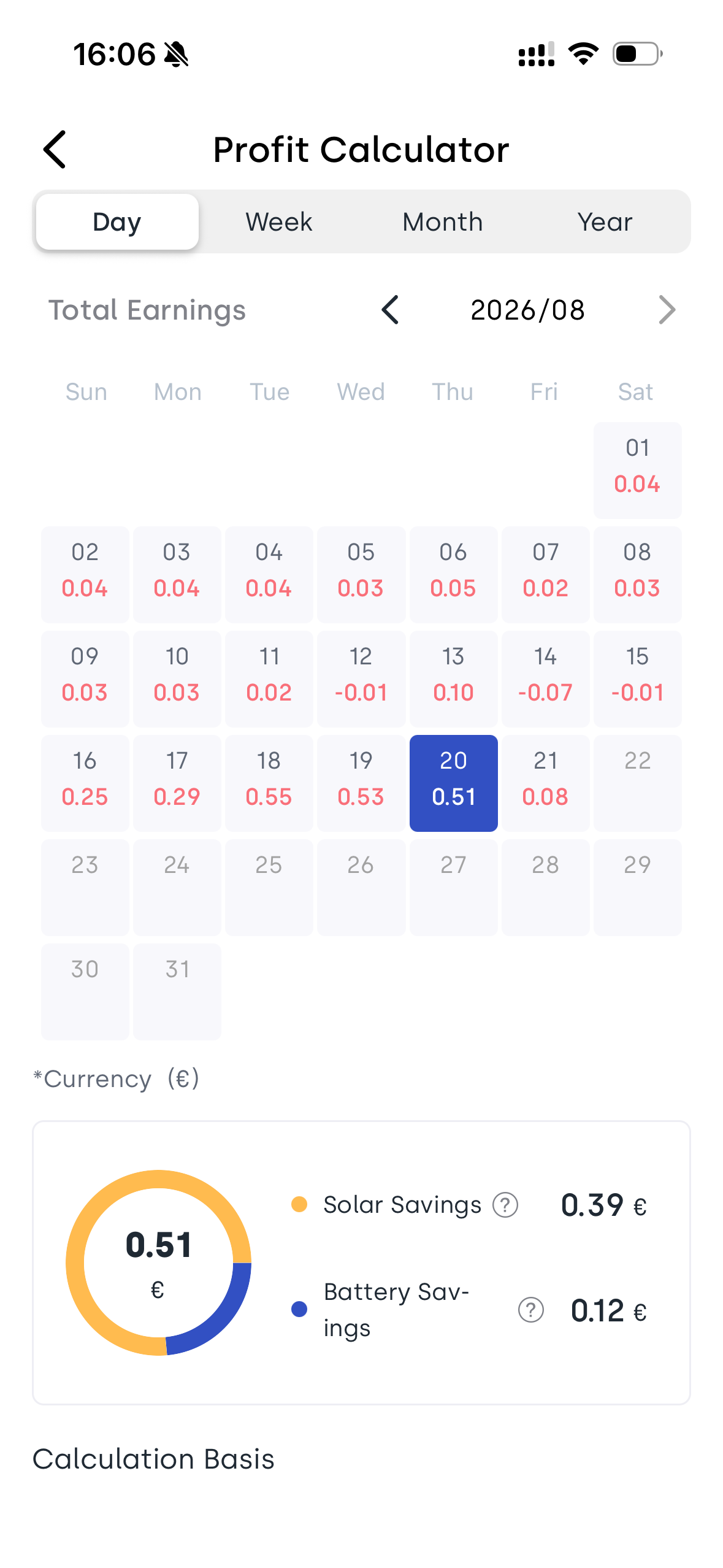
- PV earnings: €0.39
- Storage earnings: €0.12
- Total earnings: €0.51
Calculation relationship: 0.39 + 0.12 = 0.51, i.e., total earnings = PV earnings + storage earnings.
Earnings Calculation Process
The system calculates PV earnings and storage earnings by comparing the electricity costs of the three scenarios:
| Item | Calculation Method | Result |
|---|---|---|
| PV earnings | Electricity cost without PV − Electricity cost with PV only | €0.39 |
| Storage earnings | Electricity cost with PV only − Electricity cost with PV + storage | €0.12 |
| Total earnings | PV earnings + Storage earnings | 0.39 + 0.12 = €0.51 |
The specific electricity costs for the three scenarios are simulated by the system backend and are not directly displayed in the App.
Alternative Understanding
Total earnings also equal electricity savings plus feed-in revenue, requiring data on grid purchases, feed-in amounts, and electricity prices.
On the "Grid" tab of the statistics page, you can see the day's grid purchase and feed-in amounts:
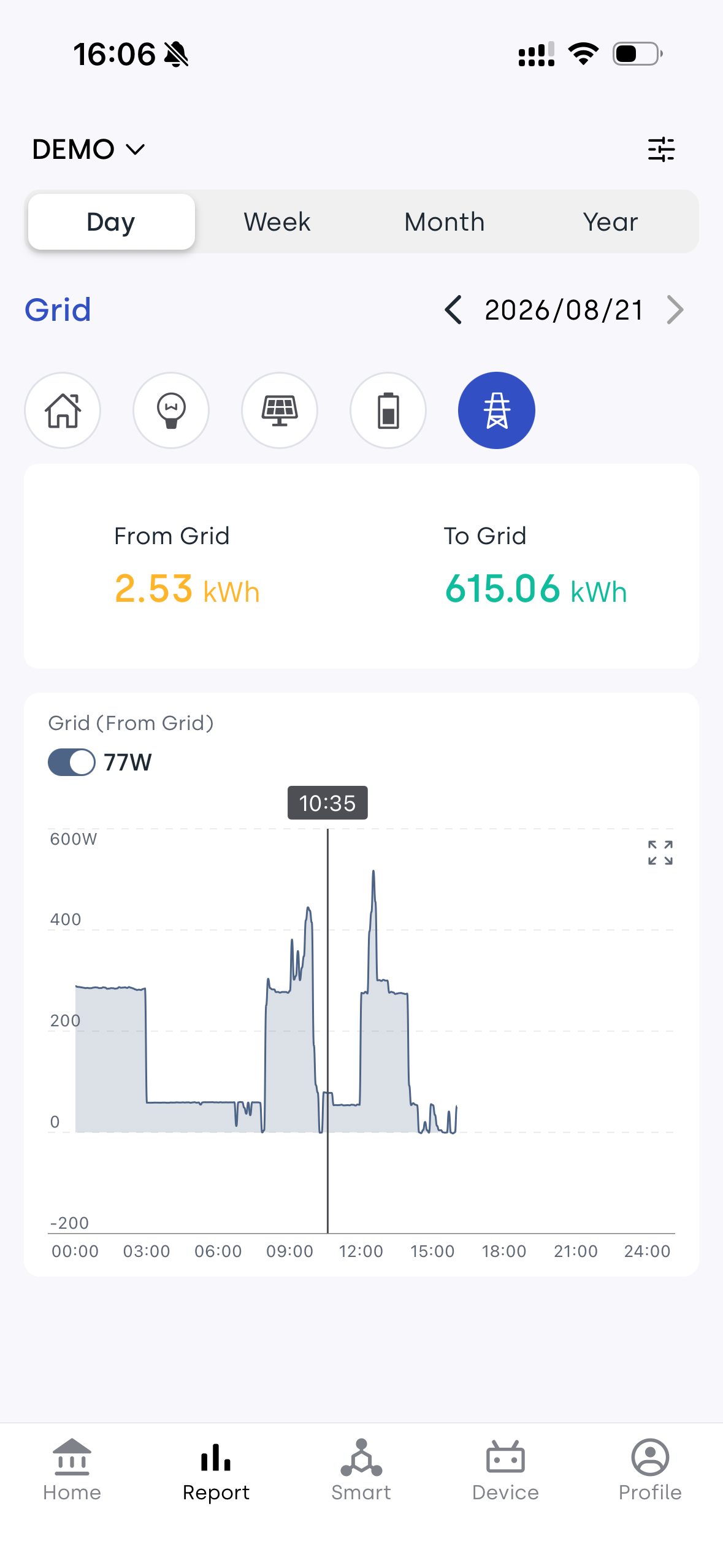
- Grid purchase: 3.49 kWh
- Feed-in amount: 615.07 kWh
On the "Historical Electricity Prices" page, you can see the day's purchase price and feed-in tariff:
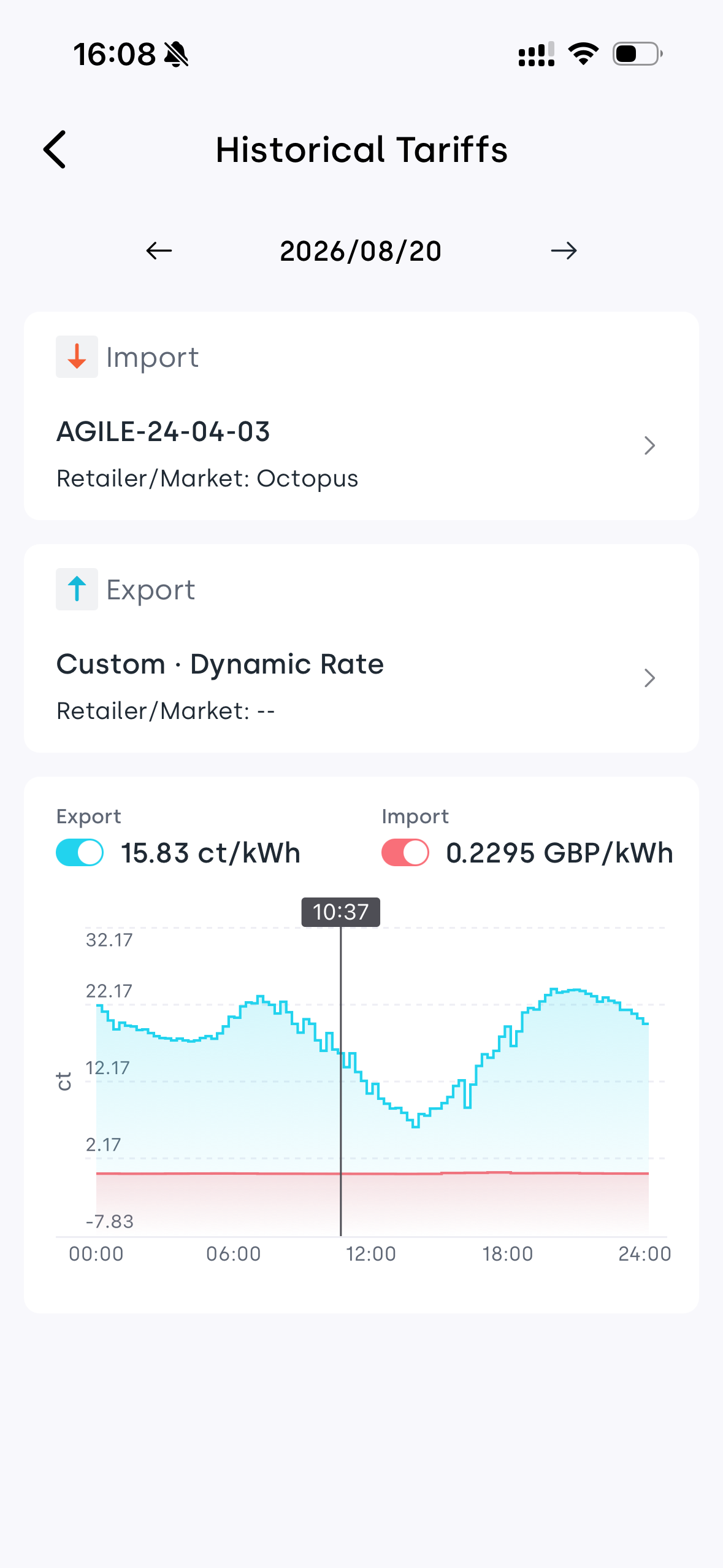
- Purchase price: 0.2295 GBP/kWh
- Feed-in tariff: 15.83 ct/kWh
Current actual electricity cost = Grid purchase × Purchase price − Feed-in amount × Feed-in tariff.
Total earnings = Electricity cost without PV and storage − Current actual cost = Electricity savings + Feed-in revenue. Both methods yield the same result.
Note: The earnings shown in the App are estimates and may differ from the final bill from your utility company. See the FAQ below for more information.
5. How Are Time-of-Use Tariffs Calculated?
If different electricity prices apply at different times of the day (time-of-use tariffs) in your region, the system calculates each time interval separately and then sums them:
Actual cost for a time interval = Grid purchase in that interval × Purchase price in that interval − Feed-in amount in that interval × Feed-in tariff in that interval
6. When Might Earnings Calculation Be Inaccurate?
The following situations may prevent the system from accurately calculating earnings:
- Existing PV generation is not recorded by the household energy system.
- No independent, accurate battery power or capacity data is available.
- Purchase price or feed-in tariff is not fully configured.
- Key device data is missing, or the metering direction is incorrectly configured.
7. FAQ
Why isn't it simply "generation × electricity price"?
The PV power generated may be self-consumed, used to charge the battery, or fed into the grid – each use has a different value, so a single multiplication cannot be used.
Why can't I calculate the storage earnings myself?
Storage earnings are derived from a comparison with the "PV only, no storage" scenario. This scenario does not occur separately in reality and must be simulated by the system based on device data.
Why isn't feed-in revenue equal to total earnings?
Feed-in revenue is only part of the earnings. You also save on electricity costs through self-consumption of PV power and grid purchase avoidance from battery discharge – these are also earnings.
Why do App earnings differ from my electricity bill?
The App shows energy earnings calculated from device data and configured electricity prices. The utility bill may additionally include basic charges, taxes, tiered tariffs, subsidies, or other settlement items, so differences may occur.
Why did today's earnings change later?
Common reasons include delayed upload of device data, updated electricity prices, or a system recalculation. Please use the recalculated results after all data is complete as the final reference.
Why are earnings sometimes negative?
This is usually due to "charging at high prices, discharging at low prices" – i.e., buying electricity from the grid at a high price to charge the battery and discharging it when prices are low.